



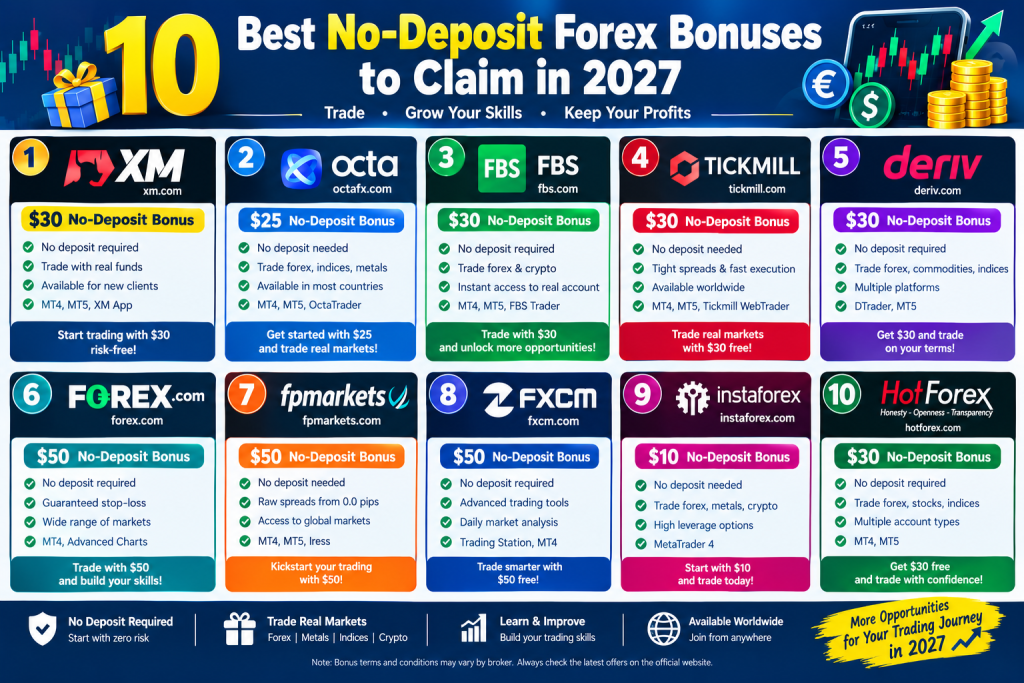
This article explains how forex no-deposit bonuses work and ranks ten brokers currently offering them for 2027. A no-deposit bonus gives new traders free credit (typically $10–$1000) after live account registration and identity verification, letting them trade real markets risk-free; the credit itself usually can’t be withdrawn, but profits earned from it become withdrawable once a minimum trading volume (measured in lots) is met, subject to expiration windows and payout caps.
The guide profiles XM, Tickmill, RoboForex, Windsor Brokers, InstaForex, JustMarkets, OctaFX, NordFX, Headway, and DB Investing, detailing each broker’s bonus amount, verification process, target trader type, volume requirements, withdrawal caps, expiry periods, country restrictions, and regulatory status (noting that FCA or CySEC-licensed brokers offer stronger protection than offshore-only ones).
It also compares no-deposit bonuses to deposit-match bonuses, emphasizing that no-deposit offers carry zero upfront risk while deposit bonuses multiply invested capital but demand far higher trading volume. Readers are advised to choose bonuses based on realistic trading pace rather than headline size, verify eligibility and regulation, and treat these offers as tools for testing broker execution and withdrawal speed rather than guaranteed income, while confirming current terms before signing up since conditions frequently change.
10 Best No-Deposit Forex Bonuses
Picking a broker in Australia isn’t as simple as it used to be. ASIC tightened leverage rules years ago, and dozens of brands still market themselves as “local” while actually routing your account offshore. If you’re searching for the best australian forex brokers, you’re probably trying to figure out which ones actually hold an ASIC license, which ones just claim to serve Australian traders, and which platforms give you fair spreads without burying you in fine print.
This guide answers that directly. We looked at regulation and fund segregation, spreads on major pairs, MT4/MT5 execution quality, and how each broker treats Australian clients specifically, not just globally. You’ll see where leverage caps apply, which brokers offer local support hours, and which ones back their offers with real trading conditions instead of marketing fluff.
Below you’ll find nine brokers worth your attention for 2027, ranked and reviewed with your actual trading needs in mind. We’ve also flagged where sign-up bonuses or a forex no deposit bonus let you test a broker’s execution before committing real capital, since that’s often the fastest way to confirm a broker’s promises match reality.
1. What to look for in an ASIC-regulated forex broker
Start with the license number itself. The Australian Securities and Investments Commission (ASIC) publishes a public register, and any broker claiming to be regulated should have an Australian Financial Services Licence (AFSL) you can look up in seconds. Don’t take a logo on a homepage as proof. Type the AFSL number into ASIC’s own database and confirm the entity name matches exactly what you’re signing up with, since some brands route Australian clients to an offshore arm that carries no local protection at all.
Next, check how your money is held. ASIC requires client fund segregation, meaning your deposits sit in a separate trust account away from the broker’s operating capital. This matters most if the broker ever runs into financial trouble; segregated funds are much harder for creditors to touch. Genuine ASIC brokers also participate in external dispute resolution through the Australian Financial Complaints Authority (AFCA), giving you a free path to escalate a dispute instead of relying on the broker’s internal complaints team.
The AFSL number is the one detail that separates a real Australian broker from a marketing page.
Leverage caps are another giveaway. ASIC limits retail leverage to 30:1 on major currency pairs and lower on minor pairs, commodities, and shares. If a site is offering you 500:1 leverage while claiming ASIC regulation, something doesn’t add up, and you’re likely dealing with an offshore entity operating under a different rulebook. This is a useful filter when you’re comparing the top forex brokers in australia, because leverage advertising is often the fastest way to spot which brands are cutting corners.
Finally, look past regulation to execution quality. Two ASIC-licensed brokers can offer wildly different spreads, commission structures, and order fill speeds. Some criteria worth checking side by side:
- AFSL status: verified on the ASIC register, not just claimed on the website
- Fund segregation: held with a top-tier Australian bank, not an offshore custodian
- AFCA membership: gives you free dispute resolution if things go wrong
- Negative balance protection: stops you owing more than your account balance
- Local support: Australian business hours and, ideally, a local phone line
Getting these basics right upfront saves you from chasing a bonus offer only to discover the broker behind it barely qualifies as Australian at all.
2. Pepperstone
Pepperstone built its reputation in Melbourne, and it’s still one of the largest ASIC-regulated brokers by trading volume. Pepperstone suits traders who want tight spreads on majors without wading through a complicated fee structure, and it’s a name that keeps coming up whenever traders discuss the best forex brokers in Australia.
Regulation and safety
Pepperstone Group Limited holds an AFSL from ASIC, and client funds sit in segregated accounts with a major Australian bank. The broker is also regulated in the UK, EU, and several other jurisdictions, which gives it a genuinely global footprint rather than a single offshore shell dressed up as local.
A broker regulated across four continents has more to lose by cutting corners on any single one.
Trading platforms and tools
You get MT4, MT5, and cTrader, plus TradingView integration for charting. Pepperstone also plugs into Autochartist for pattern recognition, which beginners often find useful when they’re still learning to read price action without hand-holding.
Fees and minimum deposit
There’s no minimum deposit requirement, and the Standard account runs on spread-only pricing from around 1.0 pip on EUR/USD. The Razor account charges a small commission but tightens spreads toward 0.0 pips, which suits higher-frequency traders who care more about raw cost than simplicity.
Who it’s best for
Active traders using MT5 or cTrader who want ASIC oversight without sacrificing execution speed will find Pepperstone hard to beat. It’s less suited to absolute beginners who want extensive educational hand-holding, since the broker leans more toward experienced traders comfortable choosing their own account type and platform.
3. IC Markets
IC Markets earned its name among scalpers and algo traders long before it became a household brand, and it still runs on some of the tightest raw spreads you’ll find from an ASIC-regulated broker. Sydney-based and built for volume, IC Markets suits anyone running high-frequency strategies or expert advisors that need fast, reliable fills rather than a polished beginner interface.
Regulation and safety
International Capital Markets Pty Ltd holds an AFSL, and Australian client deposits are held in segregated trust accounts with a major bank. The broker also operates entities regulated in Seychelles and Cyprus for clients outside Australia, so it’s worth double-checking which entity you’re actually signing up with before you deposit.
Raw spreads mean nothing if your account is sitting with the wrong regulated entity.
Trading platforms and tools
MT4, MT5, and cTrader are all supported, and IC Markets pairs them with some of the fastest average execution speeds in the industry, often quoted under 40 milliseconds. Algo traders appreciate the broker’s VPS hosting options, which keep expert advisors running close to the server with minimal latency.
Fees and minimum deposit
There’s no strict minimum deposit, though a $200 starting balance is commonly recommended to trade comfortably. The Raw Spread account charges roughly $3.50 per lot per side and offers spreads from 0.0 pips, while the Standard account folds costs into slightly wider spreads with no commission.
Who it’s best for
Scalpers, algo traders, and anyone running automated strategies will get the most out of IC Markets. If you’re comparing the top 10 forex brokers in australia specifically for execution speed, this is usually the benchmark everyone else gets measured against.
4. FP Markets
FP Markets started in Sydney back in 2005 and has grown into one of the more established ASIC brokers without losing its focus on raw pricing. FP Markets is built for traders who want IC Markets-style spreads but with a slightly broader range of tradable instruments, including shares CFDs alongside forex and metals.
Regulation and safety
First Prudential Markets Pty Ltd carries an AFSL, and Australian client funds are held in segregated accounts with a major domestic bank. The broker also runs regulated entities in Cyprus and South Africa for international clients, so Australian traders should confirm they’re signing up under the local entity to keep ASIC protections in place.
Confirming your entity, not just the brand name, is what actually protects your deposit.
Trading platforms and tools
FP Markets supports MT4, MT5, and Iress, the last of which is unusual among forex-focused brokers and appeals to traders who also want direct market access to Australian shares. TradingView charting is built into the web platform, and the broker offers Autochartist for pattern scanning across all three platforms.
Fees and minimum deposit
There’s no minimum deposit on the Standard account, which runs spread-only from around 1.0 pip on EUR/USD. The Raw account charges $3 per lot per side and pushes spreads toward 0.0 pips, putting it in direct competition with IC Markets on pure cost for high-volume traders.
Who it’s best for
FP Markets suits traders who want raw spreads but also value having equities access on the same account. It’s a strong pick if you’re comparing top forex brokers australia for a platform that doubles as a broader trading hub rather than a forex-only setup, and worth reading alongside our forex brokers review.
5. CMC Markets
CMC Markets has been around since 1989 and lists on the Australian Securities Exchange itself, which tells you something about its financial transparency compared to privately held rivals. CMC Markets stands out for its enormous range of tradable instruments and a proprietary platform that many traders rate above MT4 for charting depth, making it a regular fixture whenever people rank the top CFD and forex trading platforms in the world.
Regulation and safety
CMC Markets Asia Pacific Pty Ltd holds an AFSL from ASIC, and client funds are segregated with a top-tier Australian bank. Being publicly listed adds a layer of scrutiny most brokers never face, since CMC has to publish audited financials every year rather than just satisfying a regulator behind closed doors.
A publicly listed broker answers to shareholders and regulators at the same time, which is a rare combination in this industry.
Trading platforms and tools
While MT4 is available, most traders come to CMC for its Next Generation platform, which packs in over 12,000 tradable instruments, advanced charting with more than 115 technical indicators, and pattern recognition tools built directly into the interface. It’s a platform built for research-heavy traders, not just quick order entry.
Fees and minimum deposit
There’s no minimum deposit, and spreads on EUR/USD start around 0.7 pips with no commission on the standard account. Costs scale down further for high-volume traders through the Active Trader program, which rebates a portion of spread costs once monthly volume passes a set threshold.
Who it’s best for
CMC Markets suits traders who want deep research tools and a wide product range beyond just currency pairs. If you value platform depth over rock-bottom raw spreads, this is one of the more well-rounded picks among Australia’s established brokers.
6. FOREX.com
FOREX.com is part of StoneX Group, a US-listed financial services firm, which gives it a corporate backbone that few pure forex brokers can match. FOREX.com appeals to traders who want a global name behind their account rather than a boutique brand, and it consistently shows up when traders search for the best australia forex brokers with strong institutional backing.
Regulation and safety
FOREX.com operates in Australia through StoneX Financial Pty Ltd, which holds an AFSL from ASIC, and client money sits in segregated accounts with an Australian bank. The broker also carries licenses in the US, UK, and Canada, so its Australian arm benefits from group-wide compliance standards rather than operating as an isolated offshore entity.
A broker backed by a listed parent company has compliance pressure coming from multiple regulators at once.
Trading platforms and tools
You get MT4 and MT5, along with FOREX.com’s own web and mobile platform, which includes built-in trading signals and sentiment data showing how other clients are positioned on a given pair. Charting runs through TradingView integration, and the broker publishes daily forex news and research from its in-house analyst team, a resource smaller brokers rarely offer.
Fees and minimum deposit
There’s no strict minimum deposit, though $100 is a practical starting point. Spreads on EUR/USD start around 1.2 pips on the Standard account with no commission, while the Direct Market Access account tightens spreads toward 0.2 pips for a per-lot commission, suiting traders who trade larger volumes regularly.
Who it’s best for
FOREX.com suits traders who want the reassurance of a large, publicly accountable parent company along with solid research tools. It’s a sensible pick if you value transparency and daily market commentary over the absolute tightest raw spreads.
7. Interactive Brokers
Interactive Brokers built its name on stocks and options long before forex became a serious part of its business, and that institutional pedigree still shows in everything from margin rates to reporting. Interactive Brokers suits traders who already manage a broader portfolio and want currency exposure sitting alongside equities, futures, and bonds in one account, rather than a standalone forex platform.
Regulation and safety
Interactive Brokers Australia Pty Ltd holds an AFSL from ASIC, and client funds are held separately from the firm’s own capital in line with local rules. The parent company, Interactive Brokers Group, is listed on the Nasdaq exchange, which means it publishes audited financials that most retail forex brokers never have to disclose.
Few brokers open their books to public shareholders the way Interactive Brokers does.
Trading platforms and tools
The flagship is Trader Workstation (TWS), a dense, professional-grade platform built for traders who want order books, algorithmic order types, and cross-asset dashboards in one window. There’s also a simplified mobile and web app for traders who find TWS overwhelming, plus IBKR GlobalAnalyst for screening instruments across markets.
Fees and minimum deposit
There’s no minimum deposit for most Australian accounts, and forex pricing runs on a tiered commission model rather than spread markups, often working out to a few dollars per $100,000 traded. That structure rewards high-volume traders but can feel needlessly complex if you only trade small forex positions occasionally.
Who it’s best for
Interactive Brokers fits traders and investors who want one account spanning forex, shares, and futures rather than a dedicated currency platform. It’s a poor fit if you want a simple MT4 setup, but a strong one if you already value institutional-grade execution and reporting.
8. AvaTrade
AvaTrade has been operating since 2006 and built its reputation on offering a huge range of account types and add-on tools rather than competing purely on spread. AvaTrade appeals to traders who want an all-in-one package, from fixed spreads to automated copy trading, and it regularly appears on lists of the best forex brokers in australia for beginners who value structure over raw pricing.
Regulation and safety
Ava Capital Markets Australia Pty Ltd holds an AFSL from ASIC, and client funds are segregated with a major Australian bank. The broker is also regulated across nine jurisdictions worldwide, including Ireland and Japan, which gives it one of the widest regulatory footprints on this list.
Nine separate regulators watching the same brand leaves little room for shortcuts.
Trading platforms and tools
You get MT4 and MT5, plus AvaTrade’s own AvaTradeGO mobile app and the AvaOptions platform for currency options trading. The broker also integrates DupliTrade and ZuluTrade for copy trading, letting newer traders mirror experienced strategies while they learn.
Fees and minimum deposit
The minimum deposit sits at $100, which is higher than most brokers on this list but still accessible. Spreads on EUR/USD start around 0.9 pips with no separate commission, since AvaTrade builds its costs entirely into the spread across all account types.
Who it’s best for
AvaTrade suits beginners who want copy trading and options alongside standard forex pairs, all under one ASIC-regulated roof. It’s less appealing if you’re chasing the tightest possible raw spreads, since that’s simply not where this broker competes.
9. Plus500
Plus500 trades on the London Stock Exchange and built its name on a simple, no-frills CFD platform rather than a traditional forex broker setup. Plus500 suits traders who want a clean, app-first experience without wading through multiple account types or platform choices, and it’s a familiar name to anyone browsing the top forex brokers in australia for something straightforward.
Regulation and safety
Plus500AU Pty Ltd holds an AFSL from ASIC, and client funds sit in segregated accounts with an Australian bank. Being listed on a major exchange means Plus500 publishes audited financial statements every year, giving it a level of transparency that privately owned brokers rarely match.
A publicly traded broker has nowhere to hide bad numbers from regulators or shareholders.
Trading platforms and tools
Unlike most brokers on this list, Plus500 doesn’t offer MT4 or MT5 at all. Instead, you trade through its own proprietary web and mobile platform, which keeps things simple with built-in risk management tools, price alerts, and an economic calendar, though it won’t satisfy traders who want custom indicators or algorithmic trading.
Fees and minimum deposit
The minimum deposit is $100, and Plus500 builds all its costs into the spread rather than charging separate commissions. Spreads on EUR/USD typically start around 0.8 pips, and there are no platform or data fees beyond an inactivity charge after three months of dormancy.
Who it’s best for
Plus500 fits casual traders who want a tidy app experience over deep customization. It’s not built for scalpers or algo traders, but it’s a solid pick if simplicity matters more than platform flexibility.
10. Fusion Markets
Fusion Markets launched in 2017 with a simple pitch: cut costs to the bone and let traders keep the difference. Fusion Markets has grown fast among cost-conscious Australians, and it’s often the name that surprises people once they start comparing the top forex brokers australia has on offer against bigger, more established brands.
Regulation and safety
Fusion Markets Pty Ltd holds an AFSL from ASIC, and client funds are held in segregated accounts with an Australian bank. The broker also runs a Vanuatu-regulated entity for clients outside Australia, so local traders should confirm they’re signed up under the ASIC entity to keep full protections in place.
Low fees only matter if the entity holding your money is actually the regulated one.
Trading platforms and tools
You get MT4 and MT5, both running standard third-party plugins rather than a proprietary platform. Fusion Markets keeps things lean here, focusing spending on pricing rather than building custom software, which suits traders who already know exactly how they want their charts and indicators set up.
Fees and minimum deposit
There’s no minimum deposit, and the Zero account charges around $4.50 per lot round-turn with spreads from 0.0 pips on EUR/USD. The Classic account skips commission entirely and folds costs into spreads from around 0.9 pips, giving new traders a simpler fee structure to start with.
Who it’s best for
Fusion Markets suits cost-focused traders who’ve already compared spreads elsewhere and want the lowest all-in cost on major pairs. It’s a weaker fit if you want proprietary tools or in-house research, since the broker deliberately keeps overhead low.
11. Common questions about trading forex in Australia
Questions about legality and safety come up constantly, so let’s clear those first. Is forex trading legal in Australia? Yes, and it’s actively regulated. Any broker accepting Australian retail clients needs an AFSL from ASIC, and that license is what separates a genuine local operation from an offshore brand simply targeting Australian traffic.
Minimum capital is another common sticking point. How much money do you need to start trading forex in Australia? Most brokers on this list accept a $0 to $200 opening deposit, though a realistic starting balance for standard lot sizes is closer to $500 once you factor in margin buffers and normal drawdowns.
Leverage confusion trips up plenty of newer traders too. What leverage can Australian brokers actually offer? ASIC caps retail leverage at 30:1 on major pairs, and any site advertising far higher ratios while claiming ASIC regulation is almost certainly routing you through an unregulated offshore entity instead.
If a broker’s leverage numbers don’t match ASIC’s published caps, its regulatory claims deserve a second look.
Tax treatment is worth mentioning briefly, since it surprises a lot of first-time traders. Are forex profits taxed in Australia? Generally yes, and the Australian Taxation Office treats trading gains as either assessable income or capital gains depending on your activity level, so keep records from day one rather than scrambling at tax time.
Finally, demo accounts remain the safest way to test any of the brokers covered here. Every broker on this list offers a free demo, and running one for a few weeks before depositing real money is the simplest way to confirm spreads, execution, and platform stability match what’s advertised.
Finding the right broker for your trading style
No single broker on this list is objectively “best” for every trader. Scalpers belong with IC Markets or Fusion Markets, where raw spreads and fast execution matter more than research depth. Beginners who want structure and copy trading tend to settle with AvaTrade, while traders juggling shares and futures alongside currencies often land on Interactive Brokers or CMC Markets instead.
What matters most is verifying the AFSL number yourself before you deposit a cent, then testing the platform on a demo account until you’re confident the spreads and execution match what’s advertised. Every broker here clears that bar, so the decision really comes down to your trading style and how much you value cost versus tools.
Once you’ve shortlisted a broker, check current promotions before signing up. Browse the newest forex deposit bonus offers to see which brokers are letting you test their platform with bonus funds before you commit your own capital.