


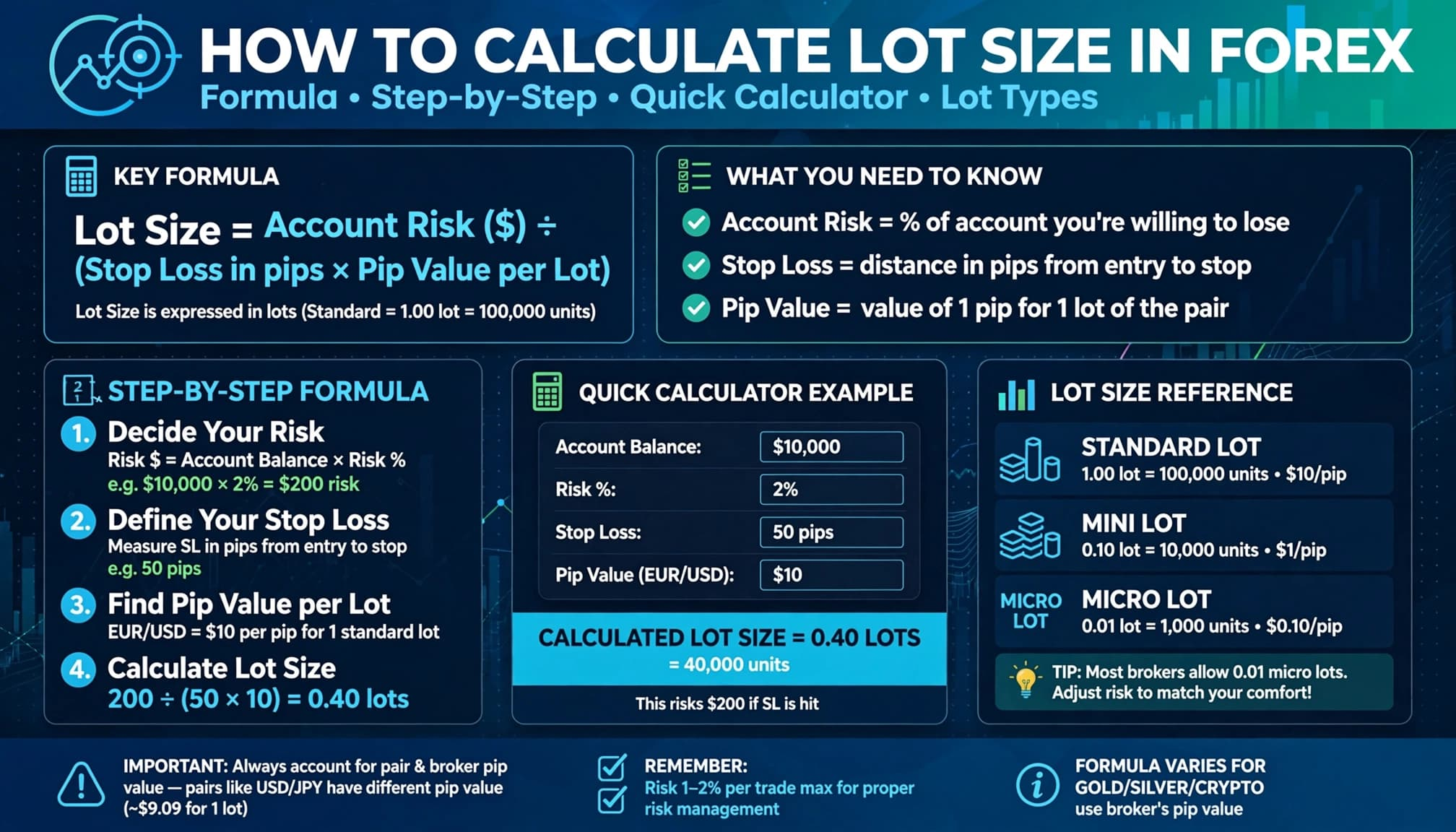
Calculating forex lot size turns a risk rule into an actual order and prevents one oversized trade from wiping out an account. The formula needs four inputs: account balance, risk percentage, stop-loss in pips, and pip value.
Lot size equals risk amount divided by stop-loss pips times pip value per lot. A standard lot is 100,000 units, a mini lot is 10,000, and a micro lot is 1,000, with pip values of $10, $1, and $0.10 on EUR/USD. Beginners should risk 1% or less per trade, using current equity rather than the starting deposit.
The stop-loss should be set by the chart, beyond a swing high or low, rather than squeezed to fit a bigger lot. Pip value is $10 per standard lot when USD is the quote currency, but it changes for pairs like USD/JPY or USD/CHF, so traders should check the platform’s contract specification. In the worked example, risking $10 on a $1,000 account with a 20-pip stop gives 0.05 lots. Always round down so risk stays under the limit. Calculators can confirm the math, and strict sizing matters especially when trading with bonus funds.
Pick the wrong trade size and one bad trade can wipe out weeks of gains. Most beginners guess their position size, or they copy a number from a forum. If you want to calculate lot size in forex properly, you need four inputs: your account balance, the percentage you are willing to risk, your stop-loss in pips, and the pip value.
The formula is simple. Lot size = (account balance × risk %) ÷ (stop-loss in pips × pip value per lot). On a $1,000 account risking 1% with a 20-pip stop on EUR/USD, you risk $10. A standard lot pays $10 per pip, so the answer is 0.05 lots. A forex lot size calculator gives you the same result in seconds, and you can check it by hand.
Below, you will walk through each input, see worked examples for different account sizes, and learn how to use a calculator with MT4 or MT5. This matters even more if you trade with a bonus such as the InstaForex no deposit bonus, where small lots and strict risk limits help you meet volume requirements without losing the funds too fast.
What lot size means and why it matters
A lot is the unit you use to size a forex trade. One standard lot equals 100,000 units of the base currency, and every price move gets multiplied by that size. Your platform lets you trade fractions of a lot, so you choose the exact exposure of each order.
Standard, mini, and micro lots
Most brokers, InstaForex included, let you trade in steps as small as 0.01 lots. In MT4 and MT5 you type the size into the volume field, so 0.01 is a micro lot and 0.10 is a mini lot. The pip values below assume EUR/USD and a USD account.
| Lot type | Volume in Forex platform | Units of base currency | Pip value |
|---|---|---|---|
| Standard | 1.00 | 100,000 | $10 |
| Mini | 0.10 | 10,000 | $1 |
| Micro | 0.01 | 1,000 | $0.10 |
Why lot size controls your risk
Think of the stop-loss as the distance and the lot size as the weight. Take a $1,000 account and a 20-pip stop on EUR/USD. At 1.00 lot, a stopped-out trade costs $200, or 20% of the Forex account. At 0.05 lots, it costs $10, or 1%. Same trade, same stop, twenty times less damage.

Your stop-loss decides how far price can move against you, but your lot size decides how much that move costs.
Calculating lot size in forex is what turns a risk rule into an actual order. Skip it and you are guessing, and one oversized trade can end an account before your strategy gets a chance to work. A bonus balance disappears just as fast as your own money.
Step 1. Set your account balance and risk percentage
Two numbers cap your loss before you open a chart. Your account balance is the money you can lose, and your risk percentage is the share of it you accept losing on one trade. Every forex lot size calculator asks for these first.
Choose your balance
Use your current equity, not your starting deposit. If a losing streak cut $1,000 to $900, you now size from $900. On a bonus account, size from the credited balance, but treat it as money that can disappear quickly.
Pick a risk percentage
Most traders risk 1% to 2% per trade. As a beginner, stay at 1% or less, because ten straight losses at 1% still leave you with about 90% of the account.
| Balance | 1% risk | 2% risk |
|---|---|---|
| $500 | $5 | $10 |
| $1,000 | $10 | $20 |
| $5,000 | $50 | $100 |
Risk amount = account balance × risk %. On $1,000 at 1%, that gives you $10, the figure you carry into Step 2.
Decide your risk in dollars first, and the lot size follows from it.
Step 2. Measure your stop-loss in pips
Your stop-loss is the price where you admit the trade is wrong. The distance from your entry to that price, counted in pips, is the second input. A pip is 0.0001 on most pairs and 0.01 on pairs quoted in yen.
Count the distance
Subtract the stop price from the entry price, then convert the gap to pips. Any calculator lot size forex tool asks for this number, so count it carefully.
| Pair | Entry | Stop | Distance |
|---|---|---|---|
| EUR/USD (buy) | 1.0850 | 1.0830 | 20 pips |
| USD/JPY (buy) | 150.00 | 149.60 | 40 pips |
Let the chart set the stop
Place the stop beyond a recent swing low or high, where the trade idea is clearly invalid. Then size the position to fit that distance. Never squeeze the stop to 5 pips just to trade a bigger lot, because normal price noise will trigger it.
Let the chart set your stop-loss, then let the stop set your lot size.
Keep the example going: you risk $10 with a 20-pip stop on EUR/USD. Those two numbers are ready for Step 3.
Step 3. Find the pip value for your pair
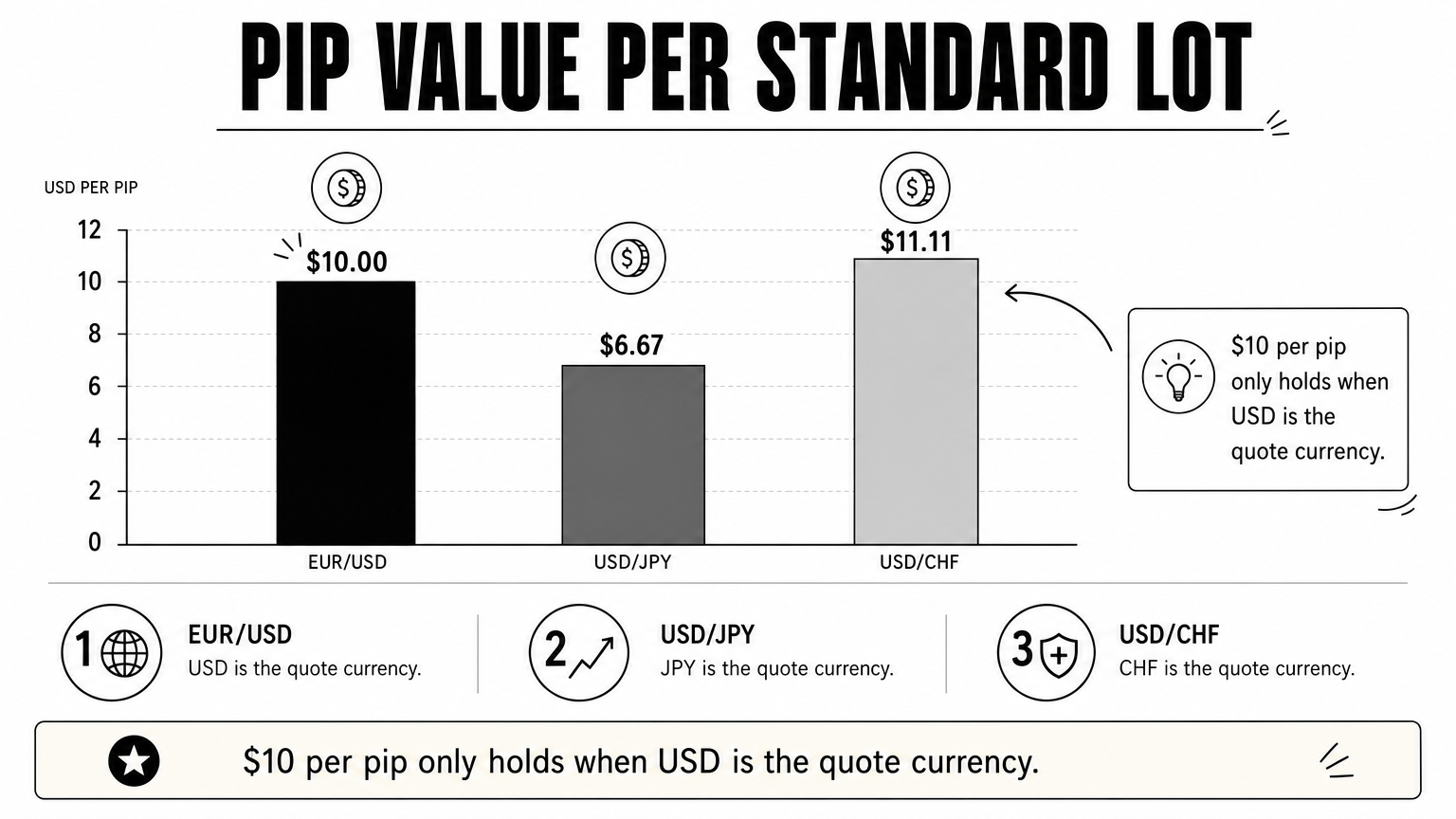
Pip value is what one pip is worth per lot, in your account currency. On pairs where USD is the quote currency, such as EUR/USD and GBP/USD, a standard lot is worth $10 per pip. Other pairs need a quick conversion.
Convert when USD is not the quote
For pairs that start with USD, divide the pip size by the current price, then multiply by 100,000. The result is the pip value for one standard lot, and it changes with the exchange rate.
Pip value per lot = (pip size ÷ exchange rate) × 100,000
| Pair | Rate | Pip value per 1.00 lot |
|---|---|---|
| EUR/USD | 1.0850 | $10.00 |
| USD/JPY | 150.00 | $6.67 |
| USD/CHF | 0.9000 | $11.11 |
Let the platform do the math
Cross pairs like EUR/GBP need conversion into your account currency, and doing that by hand invites mistakes. Open the contract specification in MT4 or MT5, or enter the pair into a lot size calculator forex tool. To calculate lot size in forex accurately, use the real pip value of the pair you trade.
Never assume $10 per pip, because the pair you trade sets the real number.
Your example stays on EUR/USD, so the pip value is $10 per standard lot. You now have all four inputs.
Step 4. Apply the lot size formula
Now you combine the four inputs. Divide your dollar risk by the dollar cost of one lot at your stop distance. That single division answers the question of forex how to calculate lot size, and the result goes straight into your order ticket.
Run the numbers
Lot size = risk amount ÷ (stop-loss in pips × pip value per lot)
Take the running example. You risk $10, your stop is 20 pips, and the pip value is $10. So 10 ÷ (20 × 10) = 10 ÷ 200 = 0.05 lots. Type that into the volume field in MT4 or MT5, and a stop-out costs you exactly $10.
Divide the dollars you can lose by what one lot loses at your stop, and you have your trade size.
Round down, then check
Rarely does the result land on a clean step. Try USD/JPY with a 40-pip stop and a $6.67 pip value: 10 ÷ (40 × 6.67) = 0.0375. Always round down, here to 0.03, because rounding up means you risk more than planned. Verify it: 0.03 × 40 × 6.67 ≈ $8, which is under your $10 limit.
Any lot size calculator forex tool runs this same division, so use it to confirm your hand math, not replace it.
Putting the formula to work
To calculate lot size in forex, you need four inputs and one division. Set your balance and risk percentage, measure your stop-loss in pips, find the pip value, then divide your dollar risk by what one lot loses at that stop. Round down, and your worst case stays inside your limit.
Run this before every trade, not just the ones that feel risky. A calculator saves time, but knowing the math tells you when a number looks wrong. Over many trades, consistent sizing matters more than any single entry, because it keeps one loss from ending your run.
Ready to practice with real market conditions? You can claim an InstaForex bonus and open a live account, then size every trade with the formula above. Read the bonus terms first, and keep your risk at 1% or less while you learn.