













Key takeaways
- A welcome bonus is a one-time offer for new clients — either free credit, a percentage added to your first deposit, or a mix of both.
- The bonus itself is almost never withdrawable. What matters is whether the profits you make with it can be withdrawn, and under what conditions.
- The lot (volume) requirement, expiry date and what happens when you withdraw decide the real value — not the headline number.
- Brokers regulated in the UK, EU and Australia generally cannot offer bonuses to retail clients, so most welcome offers come from offshore entities. Check which entity you are signing up with.
What is a forex welcome bonus?
A forex welcome bonus is a promotional reward a broker gives to a trader who opens their first live account. Its job is simple: to make the broker stand out at the exact moment you are choosing where to trade. In return, you get extra trading capital that lets you open larger positions, survive a few more losing trades, or test the broker's execution with less of your own money at risk.
What makes a welcome bonus different from other promotions is timing and eligibility. A loyalty reward or cashback programme is aimed at existing clients; a welcome bonus is only available once — usually within a fixed window after registration — and only to people who have never held an account with that broker before.
Most welcome bonuses are credited as bonus credit rather than cash. Credit sits in a separate balance field in your trading platform. It increases your equity and free margin, so it can absorb losses and support open trades, but you cannot transfer it out. Once you meet the broker's conditions, profits generated while the bonus was active become withdrawable — and in some programmes, part of the bonus itself converts into real cash.
The four main types of forex welcome bonus
Brokers package welcome offers in different ways, and the type tells you a lot about how much risk and effort is involved.
No-deposit welcome bonus
Fixed free credit — commonly $10 to $100 — added after you register and verify. No funding needed, but profit caps and short expiry dates are typical.
First-deposit match
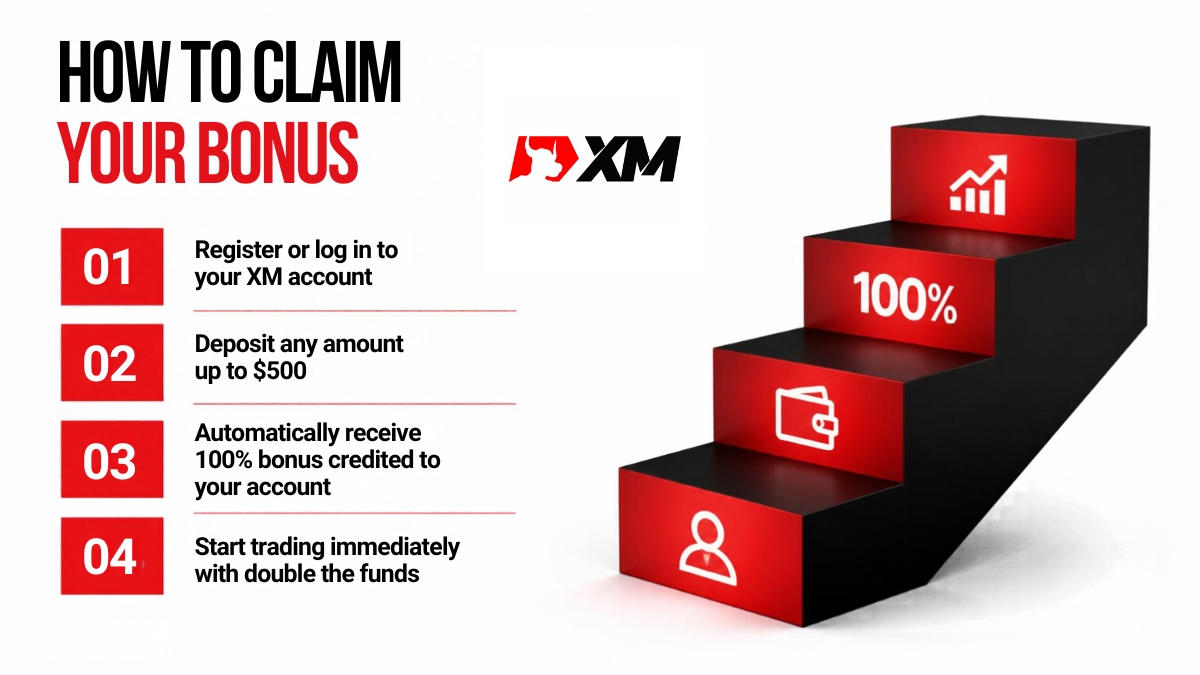
A percentage of your first deposit, such as 30%, 50% or 100%, credited as bonus. Larger in absolute terms, with volume requirements that scale with the bonus size.
Tiered welcome package
Several bonuses spread across your first few deposits — for example 50% on the first, 25% on the second. Rewards staying, but locks you into one broker.
Cashback welcome offer
Instead of credit, the broker pays back a fixed amount per lot traded during your first weeks. Smaller, but paid as real money and easy to understand.
A worked example: what a 50% welcome bonus really means
Headline percentages are easy to compare and easy to misread. Here is a simple illustration using round numbers (the exact rules differ between brokers, so always use the figures in your broker's own terms):
On paper, you have 50% more buying power. In practice, 125 standard lots is a lot of trading for a $500 account — at typical retail sizes, that could mean hundreds of trades. If the bonus also expires after 60 or 90 days, many traders simply will not reach the target, and the credit (plus any profits tied to it) is removed.
That does not make the bonus worthless. The extra equity still acts as a cushion while it is active, and partial-release programmes pay out a slice of the bonus each time you hit a volume milestone. The point is to calculate the requirement before you deposit and ask whether it matches how you already trade.
How bonus credit affects your margin and stop-out
This is the part most traders never think about until it matters. Bonus credit increases your equity, so on paper you have more free margin and can survive a deeper drawdown. But brokers treat credit differently when the account comes under pressure, and the difference decides when your positions are closed.
Model 1 — credit fully supports margin. The bonus acts like extra capital until your equity is exhausted. This gives the most breathing room, but if losses wipe out your own deposit, the bonus is consumed with it.
Model 2 — credit is removed at a threshold. Some brokers cancel the bonus once your equity falls to the bonus amount or a set margin level. Your free margin can drop suddenly and trigger a stop-out earlier than you expected.
8 terms to read before you accept a welcome bonus
- Volume (lot) requirement. How many lots you must trade before profits or bonus funds become withdrawable, and whether it is counted per bonus dollar or as a fixed total.
- Expiry period. The number of days you have to meet the requirement. Unmet conditions at expiry usually mean the credit is removed.
- Profit cap. Many no-deposit welcome bonuses limit withdrawable profit to a fixed amount, regardless of how well you trade.
- Withdrawal rules. Check what happens if you withdraw any of your own deposit before finishing — often the whole bonus is cancelled.
- Margin and stop-out treatment. Some brokers count bonus credit towards margin; others remove it when equity falls to a certain level, which can trigger an earlier stop-out.
- Eligible instruments and account types. Bonuses are sometimes limited to standard accounts or exclude crypto, indices or ECN accounts.
- Trading-style restrictions. Hedging across accounts, arbitrage, scalping under a minimum holding time and high-frequency EAs are commonly banned while a bonus is active.
- One bonus per person. Offers are limited to one per individual, household, IP address or device. Duplicate accounts can lead to the bonus — and sometimes profits — being voided.
Why regulation changes everything
Where a broker is licensed has a direct effect on whether it can offer you a welcome bonus at all. Since 2018, product-intervention rules in the European Union have restricted monetary and non-monetary incentives for retail CFD traders, and the UK's FCA and Australia's ASIC introduced similar restrictions afterwards. As a result, a broker's UK, EU or Australian entity will usually not offer bonuses to retail clients.
Most welcome bonuses you see advertised are therefore offered through a broker's international entity, often licensed in jurisdictions such as Seychelles, Mauritius, Saint Vincent and the Grenadines or Vanuatu. That is legal, but investor protections — compensation schemes, negative-balance rules and dispute resolution — can be weaker than under top-tier regulators.
How to claim a forex welcome bonus, step by step
- Pick a broker you would use anyway. Spreads, execution, platforms and withdrawal speed matter far more over a year than any one-off bonus. Start from our broker reviews.
- Read the full bonus terms. Note the volume requirement, expiry date, profit cap and withdrawal rules. Screenshot them — terms can change after you sign up.
- Register through the promotion page. Some offers only apply when you sign up via a specific link or enter a promo code at registration.
- Complete verification (KYC). Upload your ID and proof of address and verify your phone number. Most bonuses are not credited until verification is approved.
- Opt in to the bonus. Many brokers require you to activate the offer manually in the client area before you deposit.
- Make the qualifying deposit. Use a payment method that is eligible for the promotion — some e-wallets are excluded.
- Track your progress. Check the lot counter in your client area regularly, and plan your trading so you finish before the expiry date.
5 questions to ask the broker before you claim
A two-minute live chat can save weeks of frustration. Ask these questions and keep a copy of the answers:
- Which company and licence will my account be opened under?
- Exactly how many lots do I need to trade, and do all instruments count toward the target?
- If I withdraw part of my own deposit before finishing, what happens to the bonus and my profits?
- Is the bonus credit counted toward margin, and when is it removed?
- Are there restrictions on scalping, hedging, news trading or Expert Advisors while the bonus is active?
Welcome bonus vs no deposit bonus vs deposit bonus
| Feature | Welcome bonus | No deposit bonus | Deposit bonus |
|---|---|---|---|
| Who can claim | New clients only | New clients only | New and existing clients |
| Funding needed | Sometimes | No | Yes |
| Typical size | $30 – $100 or 30% – 100% | $10 – $500 | 20% – 100%+ |
| How often | Once | Once | Often repeatable |
| Main limitation | Volume target + expiry | Profit cap | Volume target scales with size |
In everyday use the terms overlap: a "welcome bonus" may be a no deposit bonus, a deposit bonus limited to your first funding, or a package that combines both. Always judge the offer by its terms rather than its label.
Which traders benefit most from a welcome bonus?
The same offer can be excellent for one trader and a trap for another. It mainly comes down to how often you trade and how large your positions are.
Beginners
A small no-deposit welcome bonus is ideal for learning live execution with zero risk. Large deposit-match offers are usually a poor fit because the volume target encourages overtrading.
Best fit: no-deposit creditActive day traders
Traders who already open many positions each week can often meet volume targets naturally, making deposit-match and partial-release bonuses genuinely valuable.
Best fit: deposit matchSwing & long-term traders
Few trades per month means volume targets are rarely reached before expiry. A cashback offer or a clean account without a bonus is usually the better choice.
Best fit: cashback offerPros and cons of a forex welcome bonus
Pros
- Extra equity to absorb drawdowns while you learn the platform
- A low-cost way to test spreads, execution and withdrawals
- Partial-release schemes can return real cash to active traders
- No-deposit versions let you trade live with zero personal risk
Cons
- Volume targets can push you to overtrade
- Withdrawing early may cancel the bonus
- Usually offered through offshore entities with weaker protection
- Trading-style restrictions can limit your strategy
Common mistakes to avoid
Choosing a broker for the bonus alone. A $50 credit is quickly outweighed by wide spreads or slow withdrawals. Treat the bonus as a tie-breaker between brokers you already trust.
Increasing your risk to hit the volume target. Doubling position sizes to unlock a bonus faster is the quickest way to lose the deposit the bonus was meant to protect. Keep your normal risk per trade — use our lot size calculator guide to stay disciplined.
Ignoring the expiry date. Set a calendar reminder for a week before the deadline so you can decide calmly whether you will make it.
Opening several accounts. Even an accidental second registration can be flagged as bonus abuse. One person, one account, one bonus.
Is a forex welcome bonus worth it?
A forex welcome bonus is worth taking when three things line up: the broker is properly licensed and has a good withdrawal record, the volume requirement fits the way you already trade, and you are comfortable with the entity and protections you are signing up under. In that case, the bonus is a genuine extra — more margin, more room to learn and, sometimes, real cash once the conditions are met.
If any of those three is missing, it is usually better to skip the bonus and trade with a clean account. You lose a small headline number, but keep full control over your money and your withdrawals.